
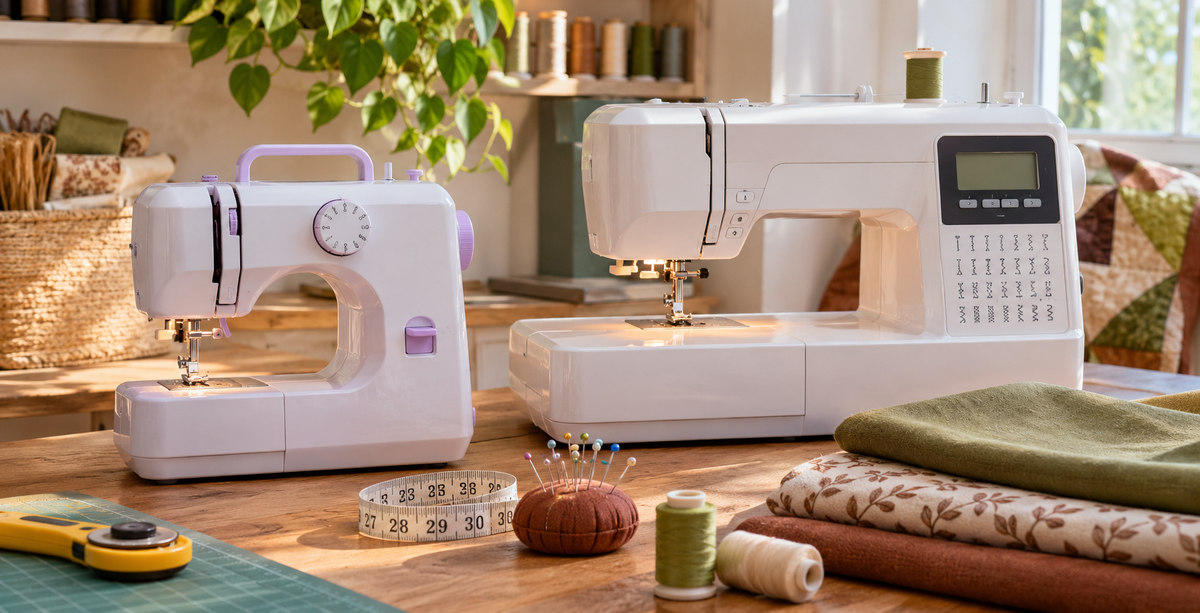
Choosing a portable vs full size sewing machine starts with one question: which projects will you sew most often?. For classes, small repairs, and frequent storage, a lightweight compact machine usually makes daily sewing easier. For quilts, coats, or long garment seams, prioritize working clearance, fabric support, and controllable feeding. A full-size domestic machine can still travel, while a mini mender may struggle with everyday garment construction.
List three real projects, including their thickest seam and largest section near the needle. Then measure your available table, storage opening, and carrying route before comparing specific machines.
Choose a small mender for occasional light hems when carrying and shelf space are your main constraints. Choose a versatile domestic machine when you sew knits, structured garments, or medium-sized quilts regularly. If both matter, check a manageable full-size machine before assuming you need two separate machines.
Compare manufacturer weight, needle-to-column clearance, feed controls, and included fabric support using the same measurement units. A machine’s size label says less about sewing capability than the exact model’s specifications and sample seams. By the end, you should know which features to prioritize for your own work and workspace.
Jump to a specific section on this article
Separating Machine Size From True Portability
Portable refers to practical movement, not a standardized body size or guaranteed lightweight construction. Some full-size domestic machines have carrying handles, modest unit weights, and protective covers. Mini menders take less room but may offer fewer stitch adjustments and less fabric clearance. The useful distinction is how easily each model handles your transport and project requirements.
Compare machine-only weights rather than mixing them with package or accessory weights. Brother lists the CS7000X at 10.5 pounds, while SINGER lists the M1000 at 5.5 pounds. Weigh the entire transport kit when calculating whether either machine works for repeated trips.
An external cabinet measurement cannot reveal the clearance beside the needle. SINGER specifies 4.25 inches of needle-to-column space and 3.75 inches of vertical clearance for the M1000. Use the same two measurements when evaluating a machine for quilts or thick coat panels.
Read descriptions of sewing machine types when sorting mechanical, computerized, mini, and domestic models by their actual functions. Stitch count alone cannot establish whether a machine will feed difficult layers. Motor performance, feed engagement, presser-foot clearance, and frame support deserve separate checks. Look for specific service manuals and supported accessories before deciding how flexible the machine will be.
Record your storage opening, machine-only weight, sewing clearance, and whether the machine has speed control. These four measures distinguish a practical portable option from a compact body with important restrictions. Choose by the combination that serves your most frequent projects, not the smallest published number.
Portable vs. full-size machines: compare by priority
Choose a priority to see practical differences for your projects and workspace.
| Consideration | Portable or compact | Full-size domestic |
|---|---|---|
| Basic repairs and hems | Suitable when stitches and foot clearance match the repair. | Suitable, often with more room around the work. |
| Clothing and knits | Choose a capable compact domestic machine; test feeding. | Check feeding and controls on the specific model. |
| Bulky quilts and coats | Limited on mini models with narrow throat space. | Prioritize measured clearance and fabric support. |
| Changing fabrics | Verify stitch length, speed and suitable presser feet. | Verify the same adjustments; size is not a specification. |
| Weekly classes | Prioritize manageable packed weight and protective transport. | Check carrying comfort, case size and classroom space. |
| Shared dining table | Compact storage may make setup and packing easier. | Practical if lifting and shelving are comfortable. |
| Small cupboard | Measure body, handle, cables and stored accessories. | Measure the same dimensions and protective cover. |
| Wide fabric panels | A suitable extension surface can help support fabric. | A larger case does not automatically improve support. |
| Slow-speed control | Test pedal response and any electronic speed limiter. | Check exact controls; the design label cannot confirm them. |
| Presser-foot pressure | Verify whether the exact model offers adjustment. | Verify separately; some computerized models omit it. |
| Thick seam junctions | Test the required layers at a slow sewing speed. | Use the same real-seam test rather than relying on weight. |
| Parts and service | Confirm compatible bobbins, feet and local repair support. | Confirm exact-model parts and service availability. |
Showing sewing projects: four considerations.
This compares practical trade-offs, not test results. Verify each model using its manual and your own fabric samples.
Carrying a Portable or Full-Size Machine to Classes
For weekly classes, carrying comfort can matter as much as the sewing machine’s stitch selection. Measure stairs, public transport transfers, and the distance from your vehicle to the classroom. A carrying handle helps with brief lifts, while a fitted padded case protects controls in transit. Ask whether the machine can remain at the venue before buying solely for low weight.
For light mending, the SINGER M1000.662 White Mending Machine has a manufacturer-listed machine weight of 5.5 pounds. SINGER specifies four built-in stitches that support 32 applications, including simple seams and hems. Its compact sewing space and light-to-medium fabric focus make it a poor choice for bulky projects.

- ✅ LIGHTWEIGHT & PORTABLE: Weighing just 5.5 lbs, this compact sewing machine is perfect for small spaces, travel, or beg…
- ✅ INCLUDED ACCESSORIES: Comes with an all-purpose foot, transparent Class 15 bobbins, extra needle, and manual threader—…
- ✅ 32 STITCH APPLICATIONS: Offers versatile stitch options like straight, zigzag, blind hem & more—ideal for mending, gar…
A mechanical machine with a steady base can still travel well in a fitted case. Protect the needle assembly and spool pins before moving any machine. Place the controller where it cannot scrape painted surfaces during transport. Avoid using a loose strap that transfers pressure directly to a handwheel.
Class locations may have shallow tables that make bulky carrying cases inconvenient. Ask the organizer about sockets, table depth, and whether machines remain overnight. Pack the manual, suitable needles, matching bobbins, and a few fabric offcuts.
If your class mainly covers basic hems, manageable packed weight and quick setup may take priority. For garment construction or quilting classes, favor usable fabric support over the smallest transport footprint.
Storing Sewing Machines in Shared Rooms
A shared dining table benefits from a machine you can set up and clear away without strain. Measure shelf width, depth, and height, allowing extra room for protruding controls. Check the lifting height before choosing any machine that will live in an overhead cupboard.
The storage route should be clear enough to carry the machine with both hands. A hard cover protects against incidental bumps better than a loose dust cloth. However, a cover does not remove the need for a dry storage area. Never store a machine by pulling on its power lead.
Keep accessories together so a short repair does not require unpacking several containers. A compact machine may fit a low shelf, but its foot pedal and power supply still need space. A full-size domestic machine can also store neatly when its cover and case fit the shelf.
When sewing happens infrequently, sewing machines for occasional use can be compared by setup effort and storage needs rather than appearance alone. Store the machine upright as its manual directs, with the presser foot and needle protected. Allow room to lift the machine without catching the spool pin on a shelf. Dry hands and clean surfaces reduce unnecessary moisture transfer during storage.
Place the foot control beside the machine without bending its cable sharply. A dedicated tray keeps extension tables and accessories from being misplaced.
Choose the machine you can retrieve safely without disturbing the room every time.
Comparing Usable Sewing Space for Bulky Projects
Fabric bulk, rather than total project length, determines how much room you need beside the needle. A rolled quilt, thick coat, or stuffed cushion can obstruct the machine column during turns. The bed supports fabric at the feed dogs, while the surrounding table supports its remaining weight. For bulky projects, judge clearance and support separately instead of relying on overall machine width.
Fold an unfinished project to the thickness you expect beside the needle. Check whether it rotates easily without brushing the handwheel or controls. For a quilt, test the rolled center rather than the thin outer binding.
Support can fail on the left side even when the needle area looks spacious. Heavy fabric hanging over an edge may pull against accurate guiding. An extension surface can help prevent that drag without changing the feed mechanism.
Compare the flat bed and any extension table as one usable fabric-support area. A larger outer case does not automatically provide better support for wide panels. A narrower machine with an appropriate extension can outperform a larger body on supported surface area.
Mark the path for the fabric before deciding that a wider case is necessary. Choose clearance based on the way your projects turn at the needle.
A practical trial with folded material reveals handling restrictions that showroom labels cannot.
Throat Clearance for Quilts and Coats
Throat clearance measures the open space between the needle and the machine column. Measure horizontal width and vertical height because bulky quilts need both dimensions. SINGER lists the M1000 at 4.25 inches wide and 3.75 inches high in this opening. That compact clearance suits small repairs better than repeatedly turning a dense quilt roll.
For planning larger work, compare quilt bulk with sewing machine throat space before choosing a machine body.
Never push a rolled quilt hard against the needle bar.
Check the passage beside the needle with the presser foot raised and lowered. If fabric cannot rotate without catching, the machine is unsuitable for that bulky project. Repeat the clearance trial using your most awkward seam junction, not a flat cotton sample.
Bed Support for Wide Fabric Panels
Fabric spreading across a table can pull a narrow sewing bed sideways. An extension table reduces unsupported material around the needle but adds setup space. Check that the table locks securely and sits level with the sewing surface. Support farther from the needle still needs a stable worktop or auxiliary table.
A slippery surface may allow large fabric panels to drift unexpectedly. Practice turning a broad panel while keeping its weight supported. Do not assume every full-size machine includes an extension table.
A machine with a narrow case can sometimes accept a useful separate work surface. An extra table changes the storage footprint and the packing routine. Loose extension sections can shift when a heavy fabric bundle crosses a joint. Examine attachment instructions before adding a homemade support platform.
A continuous level surface helps prevent material weight from pulling against feed movement. Choose the support shape that matches your main fabric direction. Plan where unused panels will rest during long seams.
Comparing Fabric Feed on Knits and Thick Seams
Feed quality depends on the fabric, feed dogs, presser foot, needle, and stitch settings. A portable machine can feed ordinary cotton well while struggling with elastic knits or bulky seams. Evaluate these materials separately instead of assuming that body size predicts feeding strength.
To compare knit handling, sew matching scraps at the same stitch length and operator-controlled pace. A stretch or ballpoint needle may reduce skipped stitches and fabric damage on appropriate knits. Where supported, presser-foot pressure adjustment can help manage uneven feeding or stretching. Check the actual controls because Brother lists no adjustable presser-foot pressure on the CS7000X.
Thick seam junctions test low-speed control and presser-foot clearance more than decorative stitch count. The Janome 2212 Front-Loading Sewing Machine uses a five-piece feed dog and front-loading bobbin. Janome specifies twelve stitches, a maximum five-millimeter stitch width, and four-millimeter stitch length.
Those Janome specifications describe mechanisms and settings, not independently measured seam performance. At thick junctions, compare motor power and torque alongside needle choice, foot clearance, and fabric support. Try the same folded seam on each candidate without pulling material through the feed dogs. Reject any machine that consistently stalls or skips stitches on your required project sample.
On knits, compare stretch recovery and puckering after the seam rests. On thick seams, examine skipped stitches, consistent feed, and whether the motor hesitates. Keep labeled samples so your decision follows observed results instead of showroom impressions.
Checking Stability at Your Usual Sewing Speed
Machine weight affects lifting and can influence vibration, but the table changes stability significantly. A rigid worktop often matters more than a small difference in body mass. Compare both designs at the pace you actually sew, not just their advertised maximum speed.
Position the machine on a level, rigid table with every foot touching. Unplug it before checking that the rubber feet are clean and intact. Keep fabric bundles from dragging the machine toward the table edge. Observe movement without touching the needle or obstructing moving parts.
Start with a straight seam on consistent woven fabric. Increase speed gradually while watching for rocking and uneven fabric guidance. Repeat with the same spool, thread, needle type, and seam length.
Brother lists 750 stitches per minute as the CS7000X maximum sewing speed in its CS7000X specifications. The same manufacturer page gives a unit weight of 10.5 pounds and 70 built-in stitches. Those are manufacturer specifications, not independent measurements of vibration or stitch consistency. Use identical woven test seams on a stable table to judge how controlled each machine feels.
A folding table can magnify movement that looks like a problem with the machine. If the machine shifts, stop and inspect its feet and the table surface. Select the setup that stays stable at your everyday sewing speed.
Comparing Controls on Compact and Full-Size Models
Body size does not establish whether a machine is mechanical or computerized. Compare controls for stitch length, width, reverse, speed, and presser-foot pressure individually. Choose the controls required by your projects instead of treating stitch count as a quality score.
Preset stitch adjustments can speed up mending but limit fine tuning for unusual fabric combinations. A stitch-length dial helps when alternating short seams, topstitching, and gathering. An electronic speed limiter can help beginners maintain a slow pace through corners. Verify needle-up positioning separately because many machines lack a programmable stop position.
The Brother CS7000X Computerized Sewing and Quilting Machine lists 70 built-in stitches, adjustable sewing speed, and a detachable wide table. Brother includes ten presser feet, yet does not list adjustable presser-foot pressure for this model. That package suits varied domestic projects better than the limited adjustments on a mini mender.
For small repairs, a direct stitch dial may be faster than navigating multiple menus. Check whether the foot controller varies speed smoothly rather than acting as an on-off switch. Try reverse stitching and needle positioning without taking your hands far from the work. Any control that interrupts your typical seam deserves more attention than a decorative program.
If your work is mostly hems, straight seams, and simple zigzags, prioritize dependable basic controls. If you switch fabrics frequently, prioritize adjustable settings and predictable low-speed handling.
Matching Machine Size to Reach and Posture
Machine size alone cannot correct a table or chair that forces your shoulders upward. Keep the needle area near a comfortable reach and support the fabric on the surrounding table. A trial seated at your normal working height reveals more than cabinet dimensions alone.
Sit with relaxed shoulders and elbows near your sides. Place the pedal where your foot can press without twisting the hip. Check that the needle remains visible without leaning forward continuously. Lighting should reach the stitch line without requiring an awkward neck angle.
Small beds can crowd your guiding hand, especially when turning bulky fabric. Larger bodies may place buttons and dials beyond a comfortable reach. Test both designs while seated, using the fabric thickness and seam direction you normally handle.
Measure chair height and the distance from table edge to needle. Keep most fabric weight on the table rather than in your supporting arm. Reposition work at intervals instead of pulling material against the feed dogs.
Sewing comfort develops from repeated posture, not just the machine’s published dimensions. Choose the arrangement that lets you guide fabric without bracing your shoulders.
Assessing Accessories, Service, and Ongoing Ownership
Maintenance and parts support matter when a machine is your only reliable sewing tool. Check the manufacturer’s manual for cleaning, needle changes, and authorized service procedures. Verify the exact model’s bobbin class before ordering replacements. Do not assume that a similar-looking snap-on foot or bobbin will fit safely.
The number of included feet matters less than whether they suit your projects. Verify each foot by model rather than assuming that similar shanks guarantee compatibility. A supplied extension table may reduce the number of extra pieces you need.
Service networks vary by region and model, even within an established manufacturer. Ask a nearby technician whether they service the exact model before purchase. Check availability of the foot controller and needle plate, not only consumable needles. Record the support contact and what proof of purchase a repair would require.
Warranty duration is a coverage term, not a measurement of motor endurance or sewing lifespan. Brother advertises a 25-year limited warranty for the CS7000X, subject to its written conditions. Compare the coverage for individual parts and labor before assigning weight to that claim.
Avoid attaching a performance claim to an accessory bundle without testing the fabric result. Document the serial number and retain the original manual for future servicing. The best fit remains serviceable for the years you plan to keep it.
Choosing One Main Machine or a Portable Second Machine
A single capable domestic machine is usually preferable when your work ranges from hems to regular garments. For weekly classes and simple repairs, portability can become the deciding constraint. For frequent quilts or outerwear, larger clearance and stronger fabric support become more important. Buy a second machine only when travel needs conflict with your primary machine’s regular workload.
List the exact jobs you would sew away from home. Choose a compact companion only when those jobs recur enough to justify separate maintenance. Before sharing accessories, verify bobbins, needles, and foot compatibility for each exact model.
When choosing one machine, compare sewing machines for home use by project fit and usable working space. For regular lightweight repairs, a small mender may offer the simplest storage routine. For knits, garments, and quilting, choose domestic-machine controls and clearance that match actual projects.
Do not buy another machine merely to compensate for a cramped or unstable primary work surface. Different bobbin systems and threading routines also increase the number of mistakes to manage. If you need both portability and versatility, consider a lighter full-size machine before purchasing two.
If you quilt every week, rank needle-to-column clearance and fabric support first. If you travel every week, rank packed weight, safe carrying, and setup speed first. If you primarily sew knits, verify feeding and stitch adjustment before comparing external dimensions. Test the thickest seam and bulkiest fabric section from your real projects.
Pick the smallest machine that performs your regular work comfortably, rather than the smallest machine available.
Which machine design fits your sewing routine?
Choose your carrying frequency, most common project and available storage space.
Frequently Asked Questions about Portable vs Full Size Sewing Machines
Is a mini sewing machine a sensible first machine for an adult beginner?
Most adult beginners are better served by a compact domestic machine than a miniature mender. Mini models can teach threading and straight seams but may limit seam construction techniques. Test two layers of cotton, a knit seam, and a realistic hem before selecting a first machine. If a required sample skips stitches or cannot fit beneath the foot, choose another model.
A tiny throat can also make garment sections awkward to turn. The SINGER M1000 has 4.25 inches of needle-to-column space, according to its manufacturer. Its four built-in stitches serve 32 applications rather than offering 32 separately adjustable patterns.
Choose an entry-level domestic machine if you expect to grow into garment or quilting projects. Confirm adjustable stitch length, speed control, and parts support when comparing available models. A useful first machine should support the techniques you plan to learn next.
Can children learn to sew on a full-size sewing machine?
Yes, children can learn on a suitable full-size machine under close adult supervision. A stable table and correctly positioned pedal are more important than reducing body size. Use the lowest practical speed when the machine provides adjustable speed control. Teach safe hand placement before threading the needle or making the first seam. Adults should supervise power connection, needle changes, and every early practice session.
Will a compact sewing machine accept my existing presser feet and attachments?
Some compact machines accept standard feet, but compatibility must be checked for each model. Match the shank type, snap-on holder, foot opening, and intended stitch width. An apparently fitting foot can still strike the needle during wide zigzag stitching. Turn the unplugged machine’s handwheel through a full needle cycle before sewing.
Bobbins need separate verification because similar-looking classes can have different dimensions. A compact model may use a proprietary foot holder or restricted accessories. Use the manufacturer’s compatibility list rather than a broad universal-fit claim.
Can a full-size sewing machine fit into a recessed sewing cabinet?
Many full-size machines fit recessed cabinets when the cabinet opening and lift dimensions match. Measure the machine body, underside projections, and available lift platform. Check clearance for ventilation, cords, handwheel rotation, and any installed accessory tray. Plan a matching insert if the cabinet requires a flush gap around the machine bed.
A machine’s published overall width does not describe every underside obstruction. Confirm whether the lift supports the machine’s actual operating weight. A stable, level working height matters more than hiding the machine when unused.
Try the needle position with the cabinet fully raised. Make sure covers, extension tables, and accessory compartments have a storage location. Never block motor ventilation merely to achieve a flush cabinet opening.
What should I check before flying with a portable sewing machine?
Check both airline baggage dimensions and airport security rules before traveling with a sewing machine. US security screening generally allows sewing machines in carry-on and checked baggage. Cabin approval still depends on the airline’s size and stowage restrictions. Pack the machine so pressure cannot damage the needle, spool pins, or handwheel. Place the pedal and accessories in separate padded compartments when possible.
Check restrictions on scissors, cutters, and blades separately from the machine. Keep detachable sharp tools in the appropriate baggage according to current rules. Allow extra time for inspection if the machine has dense metal components.
Can I use a portable sewing machine bought abroad on my home electricity supply?
Use an imported machine only when its input label matches your local voltage and frequency. Read the rating on the actual machine or supplied power adapter, not the model family name. A travel plug adapter changes connector shape but does not convert mains voltage. Brother specifies 110 to 120 volts at 60 hertz for the US CS7000X configuration.
Check the exact regional version because the same model family can use different electrical supplies. Some compact machines use an external adapter with its own input rating. Never substitute an adapter based only on connector shape.
A qualified technician can advise when the electrical label is unclear. Incompatible voltage can damage electronics and present a safety risk. Confirm local service and warranty eligibility before importing a machine.
Use the correct rated supply rather than relying on guesswork.
Are battery-powered sewing machines useful during power cuts?
Battery-powered machines can help with basic repairs when the exact model supports battery operation. The SINGER M1000 and Brother CS7000X are corded machines, not battery-powered travel models. Compare realistic backup power needs against the electrical rating on your specific machine. Never connect a motorized machine to an unverified power source merely to finish a seam.
Should I consider a used full-size sewing machine over a new compact model?
A used full-size domestic machine is sensible if its condition, controls, and service support check out. Inspect the power cord, foot controller, feed dogs, handwheel, and bobbin mechanism for damage. Ask for a demonstration with woven fabric, stretchy material, and a thick seam junction. Decline the purchase if required functions fail or repairs cannot be obtained.
Check that the model’s manual and replacement parts remain available. Missing accessories can make a seemingly complete machine less useful. Prefer a documented service history over unsupported claims about how long the machine will last.
How can I check repair support for an unfamiliar portable sewing machine brand?
Contact the manufacturer’s support channel using the full model number and serial details. Ask whether replacement foot controllers, needle plates, and tension components are available. Confirm the nearest repair provider will accept that specific model. A generic brand name on a marketplace listing is not enough evidence of support.
Download the official manual and compare its diagrams with the actual machine. Check how warranty service works for your country and purchase channel. Ask for written information about parts availability instead of relying on broad assurances.
A useful machine should remain maintainable after ordinary wear or accidental damage. Local repair refusal can outweigh a machine’s low carrying weight. Make service access a required item on your shortlist.
Are portable sewing machines always quieter than full-size models?
No, a portable machine is not automatically quieter than a full-size machine. Motor load, mechanical condition, sewing speed, and table resonance influence the sound. Compare machines using the same material, stitch, speed, and table type. A smaller machine on a flexible table may vibrate more noticeably than a heavier model.
Listen for rattling from loose accessories separately from the regular motor sound. Avoid comparing recordings made at different distances or microphone settings. A padded surface must never obstruct ventilation or destabilize the machine.
Check whether slower sewing reduces disturbance in the room. The same machine can sound different on a folding table and a solid desk. Choose controllable speed and stable support before assuming a size category is quieter.
Use real operating conditions rather than marketing descriptions of quietness.
Choosing Between Portable and Full-Size Sewing Machines
For frequent transport and small repairs, choose a compact machine that handles your actual fabric samples. For regular garments, knits, or quilts, prioritize adjustable controls, seam feeding, and usable clearance. Compare machine-only weight, workspace, electrical supply, and parts support before making a final choice. A lighter full-size model can meet both needs when portability and project versatility matter equally.